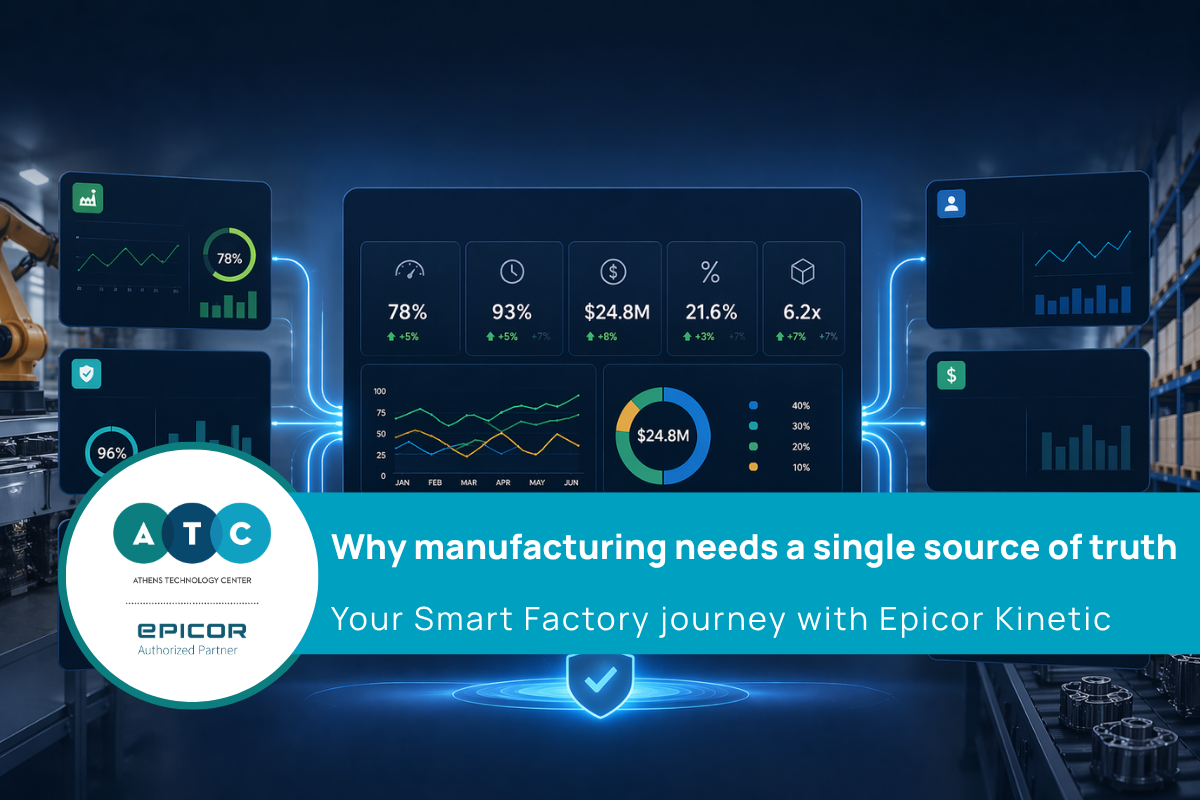

Why manufacturing needs a single source of truth
In today’s manufacturing environment, data is everywhere. Production managers, operations leaders, and executives have access to dashboards, reports, and KPIs across ERP systems, MES platforms, spreadsheets, and business intelligence tools. Yet, despite this abundance of information, decision-making often becomes slower, not better.

When dashboards create noise instead of clarity
Dashboards were meant to simplify decisions. In practice, many organizations experience the opposite.
Different departments rely on different data sources. Production data comes from MES systems, financial data from ERP, and supply chain data from separate planning tools. Spreadsheets are often used to bridge the gaps.
The result is familiar:
- KPIs that do not match across reports;
- data that is outdated by the time it is reviewed;
- dashboards that are questioned rather than trusted.
Instead of enabling action, data becomes a source of hesitation.

The real issue: multiple versions of the truth
In many manufacturing environments, each system tells part of the story—but no system tells the whole truth.
- MES reflects what happened on the shop floor;
- ERP reflects financial and transactional data;
- supply chain tools reflect planning assumptions
- Excel files attempt to reconcile everything
Even when each system is accurate individually, together they create fragmentation. This leads to:
- data latency;
- manual reconciliation;
- conflicting reports;
- loss of confidence in decision-making.

Why dashboards fail without a unified data model
Dashboards do not create trust. Data architecture does. No matter how advanced the visualization tool is, it cannot resolve inconsistencies at the source.
When dashboards are built on disconnected data:
- KPIs lag behind operational reality;
- reports require validation before action;
- decisions are delayed or avoided.
The issue is not the dashboard layer—it is what sits beneath it.
Epicor Kinetic: a single source of truth for manufacturing
To support reliable decision-making, manufacturers need an ERP platform designed to unify operational data.
Epicor Kinetic is built to function as a single source of truth by connecting:
- production data from MES and shop-floor systems;
- financial and costing data from ERP;
- supply chain and procurement data;
- quality and performance metrics.
This unified data model helps ensure that:
- teams work from the same data foundation;
- KPIs remain consistent across departments;
- reporting reflects real-time or near real-time operations.
Instead of reconciling multiple reports, teams can focus on making decisions.
From KPI overload to actionable insight
More KPIs do not improve performance. Relevant and trusted KPIs do.
High-performing manufacturers focus on a limited set of indicators tied directly to operational outcomes, such as:
- equipment effectiveness (OEE);
- scrap and quality costs;
- downtime and throughput;
- supply chain reliability;
- material cost fluctuations.
With Epicor Kinetic, these KPIs are not calculated in isolation. They are derived from a unified operational data foundation, improving consistency and decision confidence.
Analytics that extend the ERP—not replace it
Advanced analytics tools play an important role in manufacturing decision-making. Their value, however, depends entirely on the quality and consistency of the underlying data. This is also the logic emphasized in ERP-and-BI integration guidance: BI tools are most effective when they operate on unified ERP data rather than disconnected spreadsheets or siloed reports.
With Epicor Kinetic, analytics can operate on top of a connected ERP and MES environment, enabling:
- role-based dashboards for production, finance, and operations;
- drill-down analysis for root-cause investigation;
- real-time visibility into cost and performance drivers;
- scenario-based insights to support better planning decisions.
In this context, analytics does not replace ERP. It extends it.
The role of data governance in manufacturing
Reliable decision-making requires more than integration. It requires governance. Epicor Kinetic supports governance-ready data structures by helping organizations:
- standardize KPI definitions across departments
- improve traceability of operational events;
- reduce dependence on manual data manipulation;
- support consistent reporting across the organization.
What this means for manufacturing leaders
In a complex and fast-changing environment, the challenge is not access to data—it is clarity.
Manufacturing leaders need to move from:
- more dashboards → fewer, more relevant KPIs;
- more data sources → a unified data model;
- more analysis → faster, more confident decisions.
With a manufacturing-first ERP platform like Epicor Kinetic, organizations can replace KPI overload with decision clarity.
Because in manufacturing, better decisions do not come from more data. They come from data you can trust.
ATC as an Epicor Authorized Partner
As Epicor’s Authorized Partner and the Exclusive Distributor of Epicor Kinetic Solutions in Greece and Cyprus since 2001, we believe that this recognition validates our ability to provide manufacturers with the best ERP solutions.