

As part of its long-term strategy to lead globally in the use of Artificial Intelligence in higher education, Arizona State University (ASU) received a grant from the Institute of Education Sciences (IES) — the research arm of the U.S. Department of Education.
The funded project, titled:
“Active Learning at Scale: Transforming Teaching and Learning with Large-Scale Learning Science and Generative AI”
aims to develop an AI-powered educational ecosystem that leverages Generative AI technologies to enable scalable, personalized, and active learning across higher education environments.
In this groundbreaking initiative, EX-IQ, with implementation support from ATC (Athens Technology Center), worked closely with ASU to design, develop, and evaluate new learning experiences enhanced by cutting-edge AI tools.
The role of ATC
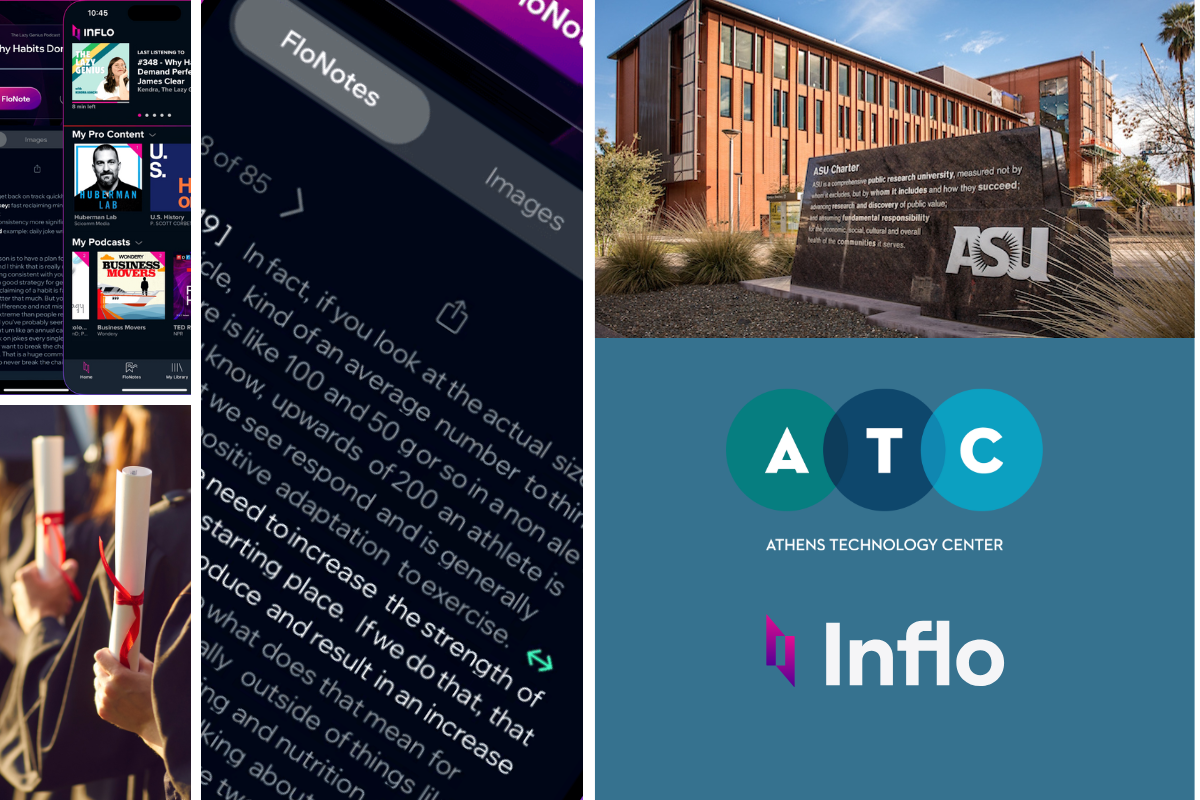
At the heart of the project lies INFLO, a mobile-first educational tool that functions as a “smart audio textbook” for university-level courses. The application allows students to listen to lectures, take notes, and highlight content, adapting seamlessly to modern, on-the-go lifestyles.
ATC was responsible for integrating Large Language Models (LLMs) into INFLO, enabling:
- Active learning features like recall questions, summaries, and self-explanations
- Real-time adaptive feedback based on student answers
- Customized learning pathways tailored to course content and individual learner needs
ATC also led the design and development of AI-driven mechanisms that enable INFLO to:
- Generate dynamic educational prompts
- Analyze student responses
- Provide personalized, ongoing learning support
The solution leverages advanced GPT-style models to deliver intelligent, interactive learning environments that respond to each student’s level and progress.
Impact on the academic community
The platform will be deployed to more than 100,000 students at ASU and Indiana University, as part of a large-scale pilot aimed at evaluating the effectiveness of AI-enhanced active learning strategies.
Expected benefits for the academic community include:
- Anywhere, anytime access to learning via mobile platforms
- Increased engagement through interactive, personalized questions
- Highly tailored learning experiences per course and learner
- Support for educational research via learning data analysis
- A scalable model that other institutions can adopt for AI integration in teaching