

In manufacturing, rising energy prices often dominate conversations about cost control. Electricity tariffs, carbon-related charges, and fuel volatility are seen as the primary threats to profitability.
But energy is rarely the root cause.
The real cost in manufacturing is unpredictability — in jobs, machines, materials, and resources.
Cost is operational before it is financial
Traditional costing methods focus on financial reporting: overhead allocation, standard costing, variance analysis. These tools are necessary, but they are backward-looking.
Manufacturing cost, however, is created on the shop floor long before it appears in financial statements.
It is shaped by:
- Unplanned machine downtime
- Scrap and rework
- Suboptimal scheduling decisions
- Material shortages
- Idle capacity caused by inaccurate planning
When these variables are unstable, cost escalates — regardless of energy prices.
By the time cost increases are visible in accounting reports, the operational cause has already occurred.
Why lean fails without real-time visibility
Lean methodologies aim to eliminate waste and stabilize production flow. However, lean cannot function without accurate and timely operational data.
Without real-time visibility into:
- Equipment effectiveness (OEE)
- Work-in-progress status
- Scrap rates and quality deviations
- Labor and machine utilization
Lean becomes theoretical.
This is where a manufacturing-first ERP platform such as Epicor Kinetic plays a critical role.
Designed specifically for industrial environments, Epicor Kinetic integrates production, materials, quality, and financial data into a unified model — enabling real-time visibility into cost drivers as they occur.
Manufacturing-centric costing with Epicor Kinetic
Predictability requires more than financial reports. It requires operational integration.
Epicor Kinetic supports:
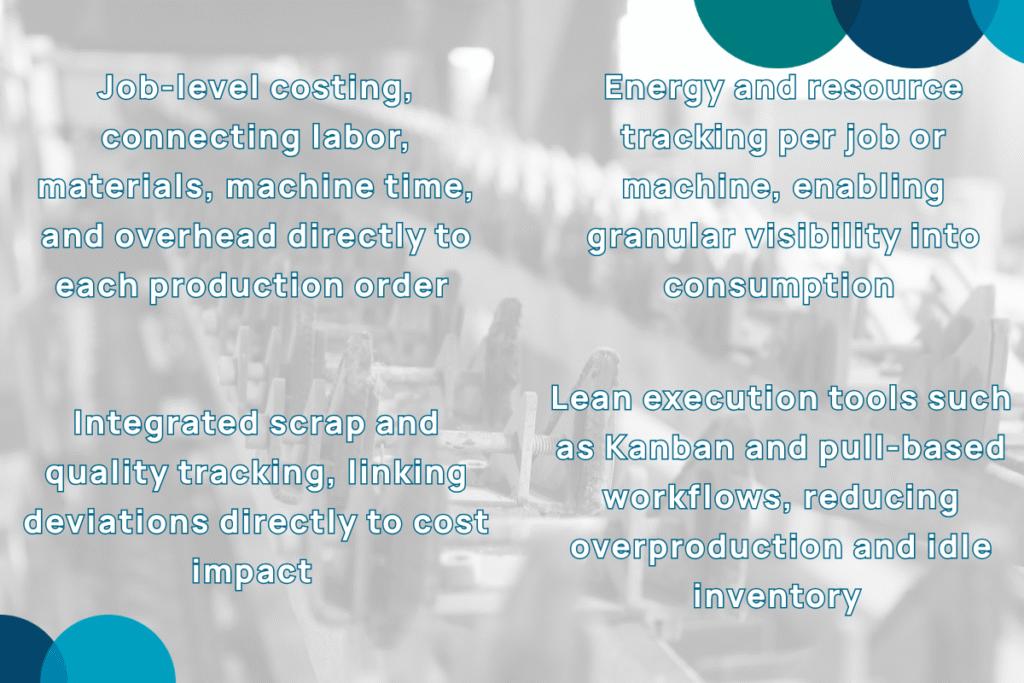
Because operational events feed directly into the ERP in real time, cost is no longer estimated after the fact — it is measured at the source.
Turning energy from risk into a variable
Energy volatility becomes particularly damaging when production lacks predictability.
With integrated planning and costing in Epicor Kinetic, manufacturers can:
- Shift production phases to lower electricity tariff periods
- Optimize batch sizes to reduce setup time and tooling changes
- Evaluate alternative routing or materials before cost impact escalates
- Analyze energy consumption per job, product, or production line
Energy becomes measurable at the operational level — not just at the utility bill level.
From cost visibility to scenario control
Beyond operational tracking, Epicor Kinetic integrates advanced analytics capabilities, including built-in reporting tools and compatibility with platforms such as Epicor Data Analytics and Grow BI.
This enables manufacturers to:
- Visualize cost per job, product, or customer
- Combine energy consumption, pricing, and equipment performance metrics
- Run what-if simulations on capacity shifts or sourcing changes
- Evaluate investment decisions such as energy-efficient equipment upgrades
When cost, capacity, and performance data coexist within a single system, scenario thinking becomes practical.
Dashboards move from retrospective reporting to proactive decision support.
What this means for manufacturing leaders
Cost optimization is not a financial exercise. It is an operational discipline supported by the right technology foundation.
With a manufacturing-focused ERP such as Epicor Kinetic, leaders gain:
- stable and realistic production planning
- transparent job-level cost visibility
- integrated lean execution tools
- scenario-driven decision support
In a volatile industrial environment, predictability is not just efficiency — it is competitive advantage.