

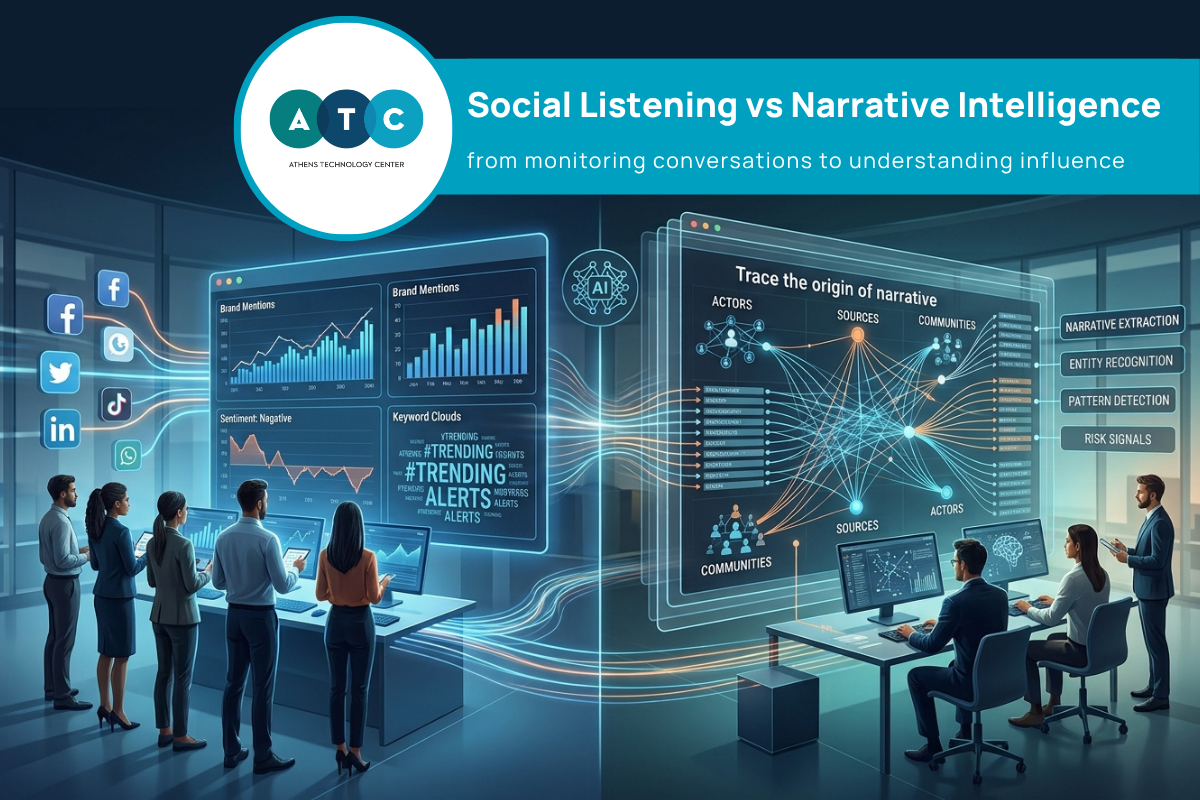

Social listening has become an essential part of how organizations track their reputation. It helps communications teams see brand mentions, changes in sentiment, rising conversation volume and content that is attracting attention.
That visibility still matters. But the information environment has changed.
A damaging story rarely begins as one obvious post. It can emerge in a niche community, reappear in a different form on another platform, acquire new claims and reach a much wider audience only after its underlying frame has taken hold. By the time a traditional dashboard shows a clear spike in volume or negative sentiment, the narrative may already be shaping how stakeholders interpret the organization.
This is the point at which social listening alone stops being enough.
Narrative intelligence adds a second layer of understanding. It helps teams investigate how a story forms, where it first emerged, which actors and sources are associated with it, how it is being amplified and why it may matter.
Social listening shows conversation. Narrative intelligence explains the dynamics behind it.
The problem is not a lack of information
Communications, public-affairs and reputation teams are not short of data. They often have more mentions, alerts, dashboards and reports than they can use effectively.
The harder challenge is making sense of fragmented signals before they become an established reputational or information risk. AI-generated content, fast-moving online communities and cross-platform amplification have made that challenge more acute. Gartner has warned that legacy monitoring tools can be inadequate in an environment shaped by AI-fuelled disinformation, and it describes narrative intelligence as a means for communications leaders to analyses online narratives, content origins and the spread of disinformation.
The practical question is not whether an organization should abandon social listening. It is whether it can connect the signals it already sees into a defensible explanation of what is happening and what deserves attention.
Three signs your team has outgrown listening alone
1. You can see attention increasing, but cannot explain the story behind it
A 240% increase in brand mentions tells a team that something is happening. It does not tell the team what interpretation is taking hold, whether the story is new or recycled, or why certain audiences are responding to it.
Narrative intelligence helps move beyond the activity count. It examines recurring claims, frames and storylines so that analysts can identify the underlying narrative rather than treating every post as an isolated data point.
2. You cannot trace where a harmful claim began or how it travelled
A claim can start on a small site, a forum or a social channel, then move through different communities before appearing in mainstream discussion. When teams only monitor one channel at a time, the path can be difficult to see.
Narrative intelligence combines open-source signals across sources and time. It can help analysts reconstruct the first visible appearance of a narrative, identify moments of escalation and distinguish between genuinely new discussion and the repackaging of an older claim.
3. Your reporting identifies alerts but does not support a decision
The real test of monitoring is not whether it produces an alert. It is whether the alert gives leaders enough context to decide what to investigate, who to involve and whether escalation is warranted. Gartner’s public guidance on AI-powered disinformation stresses the importance of clearer ownership, escalation paths, response protocols, verification and better listening capabilities. Narrative intelligence supports that wider operating model by helping teams convert fragmented observations into structured, investigation-ready insight.
Social listening and narrative intelligence are complementary
The distinction is not a choice between an “old” and a “new” tool. Social listening remains highly useful for campaign measurement, audience reaction and brand awareness. Narrative intelligence answers a different set of questions.
A social-listening report might say: “Conversation about the organization increased sharply this week.”
A narrative-intelligence investigation asks: “Which story triggered the increase, where did it first become visible, who is amplifying it, how is it changing across information environments and what should the organization examine next?”
That distinction matters when the risk is not only high visibility, but also the formation of a persistent public interpretation.
What narrative intelligence adds to a monitoring workflow
Narrative intelligence applies analytical methods to the connections between content, actors, sources and time. In practical terms, a workflow may include the following elements.
AI makes this work more scalable by helping analysts group related material, identify entities, and compare signals and surface patterns across large volumes of publicly available information. OSINT provides the evidence base: news sites, websites, public social content, blogs, forums, datasets and other open digital environments.
The result should not be automated certainly. AI cannot determine intent, credibility or factual truth on its own. The purpose is to help human analysts find the relationships and patterns that deserve further investigation — earlier and with more context.
From reactive monitoring to earlier awareness
The value of this approach is not that it predicts every future crisis. It is that it gives teams a clearer view of how a narrative is developing while more response options remain available.
That is increasingly important in a landscape where misinformation and manipulation can move quickly across channels. Gartner predicts that by 2027, 50% of enterprises will invest in disinformation-security products or services and TrustOps strategies, up from fewer than 5% at the time of its public statement. The broader direction is clear: organizations are moving from passive monitoring toward more structured approaches to information risk.
For communications and reputation teams, this means being able to answer four practical questions sooner:
- What is the emerging narrative?
- Where did it come from and how is it spreading?
- Which actors, sources or communities are associated with it?
- What evidence and context are needed before deciding whether to act?
How ATC supports narrative intelligence
ATC combines AI-enabled analysis with open-source intelligence to help organizations transform fragmented public information into structured insight. Its approach brings together narrative extraction, entity recognition, network analysis, pattern detection and timeline reconstruction to support research, monitoring and decision-making across digital information environments.
This can be relevant for organizations monitoring reputational threats, misinformation and disinformation, emerging public narratives, executive or brand exposure, policy issues, or rapidly evolving information environments. The goal is not to replace communications judgment. It is to give people responsible for that judgment a more complete analytical picture.
Read more:
- What CCOs Need to Know About Narrative Intelligence: according to Gartner (Feb 2026) legacy monitoring is increasingly inadequate in the face of AI-fueled disinformation; narrative intelligence helps CCOs analyze online narratives, content origin and the spread of disinformation.
- Tech-Enabled Reputation Management for CCOs | Gartner: according to Gartner (Jun 2026) narrative intelligence can track how stories form, travel and gain traction; early-signal detection can help communications leaders identify issues while they are still