

Global trade is becoming harder to predict. Tariff changes, shifting trade policies, energy volatility, and transportation cost fluctuations are creating new pressure for manufacturers.
For manufacturing companies, the impact goes far beyond import duties. Tariffs can affect raw material costs, supplier competitiveness, delivery timelines, inventory strategies, pricing decisions, and profit margins.
The problem is not only that costs are rising.
The bigger problem is that many manufacturers cannot quickly assess which sourcing, pricing, or production decisions will protect margins when conditions change.
Tariffs are no longer just a finance issue
Tariffs used to be treated mainly as a trade or compliance issue. Today, they affect operational decisions across procurement, production, finance, logistics, and sales.
Manufacturers need to understand:
- which materials or components are exposed to tariff increases
- how supplier price changes affect production cost
- whether tariff-driven cost increases can be absorbed or passed through
- which customer commitments are at risk
- how alternative suppliers affect lead times and quality
- how inventory policies should change when tariffed goods become more expensive.
The key point: tariff pressure is now a cross-functional business issue.
Why static costing is no longer enough
Many manufacturers still rely on static costing models or delayed financial reporting to understand cost changes.
That approach is risky.
By the time the impact appears in reports, the business may already have:
- accepted unprofitable orders,
- committed to outdated quotes,
- purchased from a more expensive supplier,
- increased inventory carrying costs,
- delayed customer deliveries,
- lost margin without realizing where it happened.
In a volatile environment, manufacturers need dynamic landed cost visibility.
Landed cost: seeing the real cost of sourcing
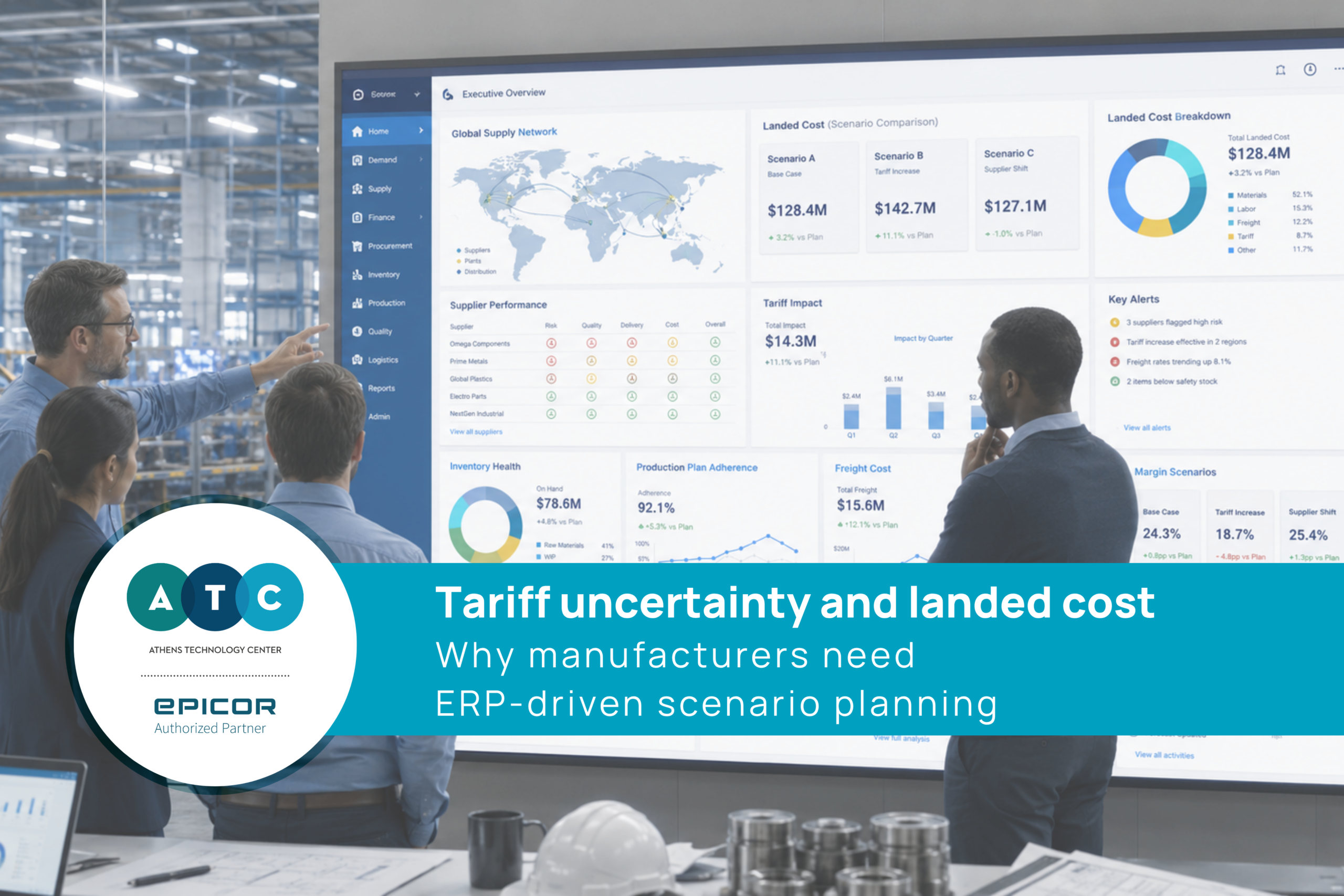
Landed cost gives manufacturers a more complete picture of what a material or component actually costs once all relevant expenses are considered.
This may include:
- supplier price,
- duties and tariffs,
- freight,
- insurance,
- customs fees,
- brokerage costs,
- currency impact,
- handling and logistics costs.
Without landed cost, a supplier may look cheaper on paper but become more expensive once the full supply chain cost is considered.
This is especially important for manufacturers working with metals, plastics, machinery parts, imported components, or project-based assemblies where material cost can heavily influence margin.
Supplier visibility: knowing which alternatives are realistic
Alternative sourcing is not as simple as switching suppliers.
Manufacturers need to know:
- whether a supplier is approved,
- whether they meet quality and certification requirements,
- whether they can support required volumes,
- whether their lead times are reliable,
- whether their pricing remains competitive after landed cost,
- whether switching suppliers creates production or compliance risk.
This is where supplier portals, supplier performance metrics, and procurement analytics become critical.
The goal is not only to find another supplier.
The goal is to identify which supplier is viable under the new cost, risk, and delivery scenario.
Scenario planning: from reactive decisions to proactive control
In tariff uncertainty, manufacturers need to answer questions quickly:
- what happens if tariffs increase by 10%, 25%, or 50% on a key material?
- what if we shift sourcing from Supplier A to Supplier B?
- what if lead times increase by two weeks?
- what if freight costs rise but supplier price decreases?
- what if we hold more inventory now but increase carrying costs?
- what if we pass part of the cost increase to customers?
ERP-driven scenario planning helps manufacturers compare alternatives using the same operational and financial data.
This shifts decision-making from reactive firefighting to proactive planning.
How Epicor Kinetic supports manufacturing resilience
Epicor Kinetic ERP helps manufacturers connect procurement, inventory, production, finance, and supplier data in one environment.
Relevant capabilities include:
- Landed cost calculation to capture the real cost of materials and imported goods.
- Supplier visibility and performance metrics to evaluate suppliers based on reliability, quality, cost, and delivery.
- Inventory and demand planning to align stocking decisions with demand, availability, and risk.
- Scenario analysis to compare sourcing, cost, and margin impact before decisions are made.
- Financial visibility and dashboards to understand where margin pressure is building.
- Supplier portals and collaboration tools to improve supplier communication and reduce delays.
For manufacturers, this creates the operational backbone needed to respond faster when trade conditions change.
Why this matters for Greek manufacturers
Greek manufacturing companies may not always be directly exposed to US tariffs. However, many are indirectly affected through European value chains, imported raw materials, packaging costs, logistics, energy prices, and customer demand shifts.
Metals, plastics, machinery, food packaging, construction materials, and industrial components can all be affected by changes in upstream costs or supplier availability.
For these companies, resilience depends on the ability to see cost changes early, compare alternatives, and make decisions before margin pressure becomes visible in financial results.
Conclusion
Tariffs, energy volatility, and trade policy changes are difficult to predict. But their impact can be modelled. Manufacturers that rely on static costing and fragmented supplier data will continue to make decisions reactively.
Manufacturers that connect landed cost, supplier visibility, inventory planning, and scenario analysis inside their ERP will be better positioned to protect margins, maintain delivery reliability, and adapt sourcing strategies with confidence.
In today’s trade environment, resilience is not about guessing what will happen next. It is about being ready to evaluate the options when it does.