
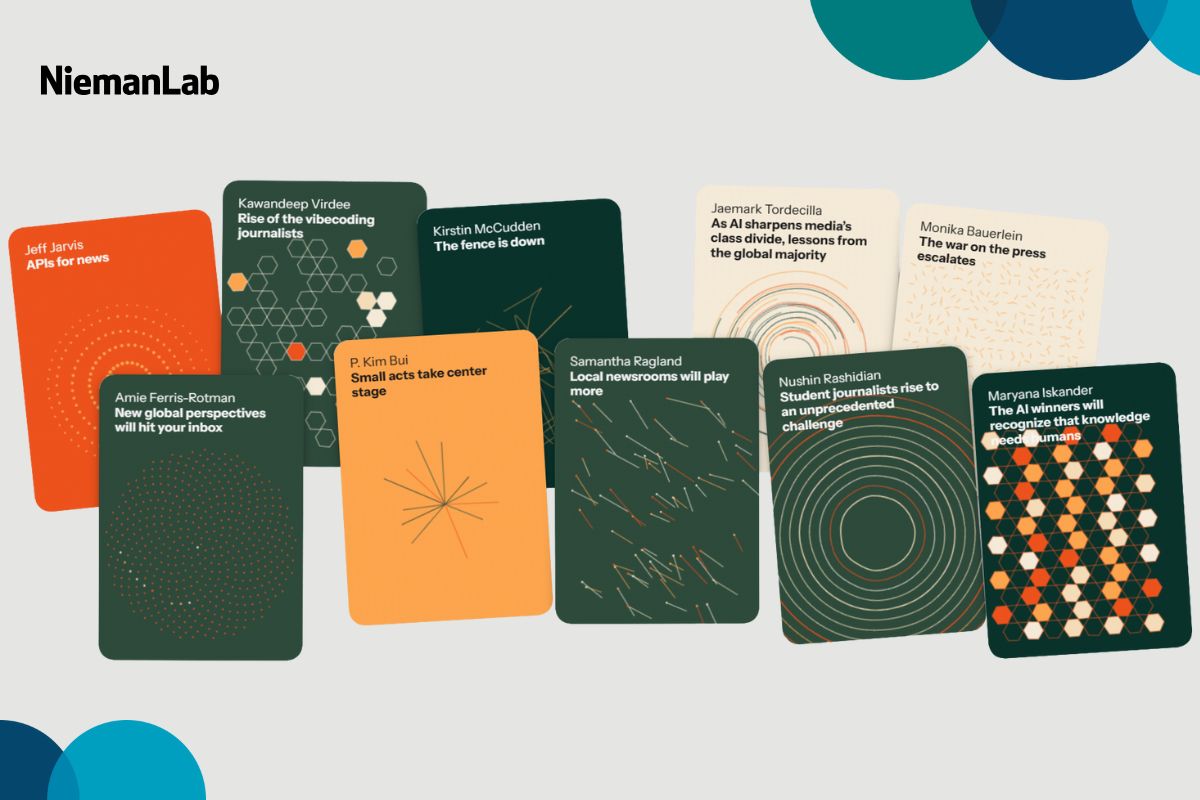

Every year, the Nieman Lab brings together journalists, editors, technologists, and media leaders to reflect on where journalism is heading next. The 2026 predictions signal a clear shift in focus: away from experimentation for its own sake, and toward sustainability, trust, and operational maturity.
Rather than treating these forecasts as isolated opinions, a broader pattern emerges. Across publishers, news agencies, and independent journalists, the conversation is converging on what it will actually take to operate credible, resilient newsrooms in the year ahead.
Below are the key themes that stand out , and what they practically mean for the media ecosystem.
From AI hype to AI accountability
One of the strongest signals across the 2026 predictions is a growing fatigue with AI hype. The conversation is moving away from eye-catching demos and toward more grounded questions: reliability, governance, costs, and real newsroom value.
AI is no longer seen as an add-on or a shortcut. Instead, it is increasingly treated as editorial infrastructure, something that must integrate smoothly into workflows, respect editorial standards, and support journalists rather than overwhelm them.
For news organizations, this marks a turning point. Success in 2026 will not be defined by how quickly AI tools are adopted, but by how responsibly and coherently they are embedded into everyday editorial operations.
Trust becomes an operational issue
Trust appears throughout the Nieman Lab predictions, not as an abstract value but as a practical challenge. Verification, transparency, and explainability are increasingly framed as operational requirements, not just ethical ideals.
In an environment shaped by misinformation, synthetic content, and declining public confidence, credibility depends on systems and processes as much as on editorial intent. How content is verified, how sources are validated, and how editorial decisions are documented all play a role in reinforcing trust.
For publishers and agencies alike, this means that trust in 2026 will be built less through declarations and more through consistent, visible practices embedded into the newsroom workflow.
Audience relationship matters more than traffic
Another recurring theme is the changing nature of audience value. The predictions reflect a growing consensus that traffic alone is no longer a sufficient measure of success.
Instead, attention is shifting toward long-term relationships: loyalty, habit, relevance, and engagement over time. This applies across business models, from subscription-based publishers to agencies serving professional clients.
For journalists and editors, this shift changes priorities. Content is increasingly evaluated not just on reach, but on whether it deepens understanding, serves a clear audience need, and strengthens the relationship between newsroom and reader.
Fragmentation is not a phase; it is the new normal
The 2026 outlook leaves little doubt that fragmentation across platforms, formats, and channels will continue. More distribution points, more content formats, and more audience touchpoints are becoming the baseline, not the exception.
What stands out in the predictions is not a call for simplification, but for coordination. The challenge is no longer the lack of tools, but the lack of coherence between them.
In this context, resilience comes from connected workflows and shared editorial visibility, enabling teams to manage complexity without losing focus or consistency.
Editorial leadership faces harder trade-offs
A quieter but powerful theme running through the predictions is the growing pressure on editorial leadership. As resources remain constrained and expectations continue to rise, editors are increasingly required to make strategic choices about what not to do.
The year ahead is portrayed less as a time for broad experimentation and more as a period of prioritisation. Decisions around coverage depth, technology investment, and workflow design will define not only efficiency, but editorial identity.
Leadership in 2026 will be measured by clarity and direction, rather than by the number of initiatives launched.
From reactive publishing to contextual journalism
Finally, many of the predictions point toward a renewed emphasis on context. In a world of constant updates and information overload, the value of journalism increasingly lies in explanation, synthesis, and perspective.
Rather than competing solely on speed, news organizations are being pushed to help audiences make sense of complexity. This applies equally to breaking news, investigative reporting, and specialized coverage.
For journalists, this shift reinforces a familiar truth: relevance comes from insight, not volume.
Looking ahead
Taken together, the Nieman Lab’s 2026 predictions outline a more mature phase for digital journalism. Technology remains central, but it is no longer the story. Trust, coherence, and editorial judgment are moving back to the foreground.
For publishers, news agencies, and journalists, the year ahead will be less about chasing the next trend and more about strengthening the foundations that allow quality journalism to endure.
In that sense, 2026 may not be the year of radical disruption, but it could be the year when the industry finally consolidates what it has learned.
This article is an editorial synthesis of the 2026 journalism predictions published by Nieman Lab, curated to highlight common themes relevant to publishers, news agencies, and journalists.