

A nation at the inflection point
Greece marks a crucial turning point in its online transformation. From breakthrough use of AI by the private sector to governance-first public sector innovation, the country is no longer left behind — it is emerging as a daring case study of AI in Europe.
“AI adoption in Greece increased by 55% year-on-year – the second fastest growth rate in Europe.”
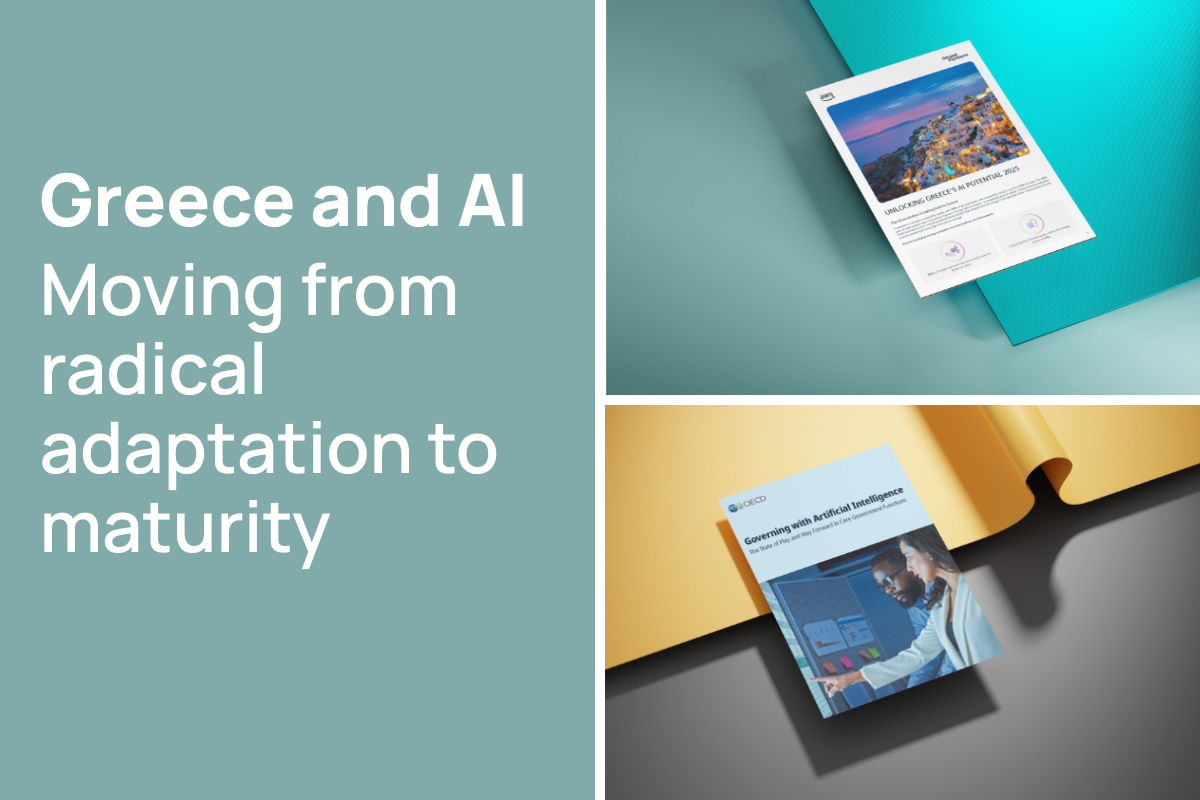
AWS’s Unlocking Europe’s AI Potential research shows that AI adoption in Greece increased 55% year-on-year — the second-fastest growth rate in Europe. Indeed, in the wake of AWS’s report, some 60,000 Greek businesses have reported to have implemented AI over the past year — roughly one every eight minutes. But the true opportunity needs to be found in governance, trust, and human capability.
Greece ranks among the frontrunners of public sector AI innovation, meaning that responsible, transparent deployment is capable of propelling adoption throughout the economy, according to the OECD.
This is not simply a moment of digital transformation — it’s an opportunity to redefine how Greece competes, governs and builds value within the era of intelligence.
Private sector: fast adoption, uneven maturity
Growth, performance, and value
AI (artificial intelligence) is not just an ambition for Greek businesses in the past, but an emerging reality. According to the AWS study,
- 34 per cent of Greek businesses now use AI — up from 22 per cent last year;
- among those adopting, 89% report higher revenues, and 18% report measurable productivity gains.
“AI isn’t experimental anymore — it’s a tried & true lever of growth, efficiency and resilience for Greek businesses.”
The upshot is clear: companies that intelligently use data — automating planning, forecasting, customer insights — are earning a structural edge. Greece’s startups are driving ahead.
“The divide doesn’t matter who uses AI, so long as they’re strategic about it.”
The real gap is in AI maturity, even as usage by large enterprises (45%) already exceeds the national average. Startups are leading in advanced use — 55% have launched new AI-driven products and services — while just 12% of big enterprises have a clear AI strategy in place. And so the divide isn’t really about who uses AI, but how deeply and strategically it is integrated.
The opportunity? If built entities are to progress over the long horizon from AI projects to AI-enabled operations, driven by strong governance, data maturity, and human capital.
The human factor: talent as a strategic bottleneck
Across sectors, the skills gap is still the largest cited obstacle in AI advancements. Only 18% of Greek companies have strong internal AI capabilities, and nearly half struggle to hire locally. To lure talent, Greek employers now pay 42% more for digital roles — one of the highest premiums in Europe.
Still, progress is visible. Almost one in three companies has initiated AI training programs, and those who invest in upskilling their workforce are more likely to foster adoption sooner.
Regulation & Compliance: the cost of uncertainty
Greek firms spend €43 out of the €100 of their technology budgets on regulatory compliance – even higher than the European mean (Note: The original examination did not specify AI-only compliance, but the amount is the full regulatory compliance overhead that technology companies impose on their investment)
With the EU AI Act near, 67% of companies are still uncertain about their legal responsibilities. This uncertainty delays decision-making in over 40% of startups.
“For AI transformation, technology may initiate the change — but so too do people.”
Next frontier: transition from compliance as cost to compliance as design principle — building transparency, auditability, and explainability into all AI models and every workflow.
The public sector as a catalyst for trust and scale
From tax to justice
In the context of the OECD “Governing with Artificial Intelligence” report but also based in BizNow’s coverage we find that Greece not only is one of the most widely praised countries in AI in public services but also a “public AI frontrunner”; the country has 19 projects implementing AI to fill the education, scientific research, data management and variety of administrative functions.
For instance:
- Tax compliance: the Independent Authority for Public Revenue (AADE) applies AI to identify properties that aren’t previously declared, and evaluate tax risk.
- Citizen support: AADE is working on its artificial intelligence digital assistant for tax filings.
- Land registration: the Hellenic Cadastre applies AI to identify and sort title deeds, minimizing administrative delays.
- The judiciary: AI fuels speech-to-text, anonymization, and legal chatbots, accelerating case handling.
- Children’s rights and rights: the i-ACCESS My Rights project uses conversational AI to assist minors with legal rights.
- Ethical oversight: the Ministry of Justice leads a working group on fairness, transparency, and AI ethics in legal systems.
“Greece’s public sector is not playing with AI — it’s implementing it.”
Governance and Trust as Design Principles
OECD’s more recent framework, AI in Public Service Design and Delivery, emphasizes that successful adoption hinges upon trust, accountability, and citizen oversight.
In fact, the OECD points out that responsible AI in the public sector needs to be built around
- clarifying accountability for algorithmic decisions and outcomes (automation bias);
- ensuring transparency and explainability for the citizenry;
- investment in AI literacy across the public workforce;
- fostering public–private partnerships, to speed up innovation;
- scaling beyond pilots to embed AI in the building blocks of administrative processes.
When governments allocate resources to reliable AI infrastructure, the entire economy reaps the rewards. By adhering to these criteria, governments enhance their services while simultaneously fostering public trust in technology, which paves the way for subsequent private sector innovation.
How public strategy and private adoption are converging
Indeed, the OECD report uncovers six key enablers of AI and private-sector innovation based on public sector investments:
- Filling market gaps: governments invest in AI for neglected markets and where private sector will not invest on its own (such as India’s farmer support systems, Germany’s FAIR Forward initiative).
- Providing digital infrastructure: public investment in computing, cloud, and connectivity provides the basics that eliminate impediments to private sector innovation (e.g., Greece’s DAEDALUS supercomputer).
- GovTech partnership: government procurement and early-stage startup partner market opportunities, and increase spurs innovation.
- Data knowledge sharing: open data initiatives, open-source tools, and knowledge transfer drive private sector development.
- Regulatory clarity: clear governance frameworks, regulatory sandboxes, and standards reduce risk, decrease uncertainty, and encourage private investment.
- Build market confidence: government policy adoption demonstrates the effectiveness of AI and positions it as a multiplier to private sector innovation.
Moreover, the report stresses that governments have unique advantages: they can take first-mover risks in uncertain markets, invest with longer time horizons, and produce public goods (infrastructure, data, standards) that drive benefit across the ecosystem.
Strategic alignment: Greece’s blueprint in context
Greece’s AI trajectory provides evidence that a nation is on the move: early adoption, real business value, a strong public sector, and an increasing understanding of responsible innovation. The challenge going beyond is going to be getting momentum to maturity, by alignment with skills, strategy, and governance.
The Greece AI Transformation Blueprint outlines four core strategic pillars:
- Infrastructure & Data Readiness
- Ethical & Regulatory Frameworks
- Digital Skills and Inclusion
- Research, Innovation & Ecosystem Development
These pillars are consistent with OECD recommendations as well as AWS findings and have contributed directly to aligning state priorities with the realities of enterprise.
| Strategic Pillar | OECD/AWS Link |
| Data infrastructure | OECD: Shared APIs, GovTech tools |
| Ethics & regulation | OECD: Explainability & trust, AWS: EU AI Act confusion |
| Skills gap | AWS: Only 18% AI-ready, 42% salary premium |
| Innovation ecosystem | OECD: public-private pilots, AWS: startup momentum |
Conclusion: Accelerator to maturity
Greece is no longer left behind AI revolution. With one of the most rapid uptake rates throughout Europe and with a burgeoning repertoire of public sector applications, the country is in a new stage, from ‘experiment’ to ‘institutional transformation’.
The Private sector scaled fast, even unevenly. The public sector is embedding governance principles and demonstrating what ethical AI really looks like in practice. The national strategy offers glue that keeps these moving parts on track.
What’s required now is:
- investment into AI talent pipelines
- regulatory clarity and AI-specific compliance guidance,
- improved public-private collaboration
- a move from AI projects to AI-enabled operations and services.
The next phase is not going to be shaped just by adoption rates, but by the responsible governance of AI, its enablement, and its design. The intersection of public leadership, private innovation, and ethical foresight provides Greece with a unique opportunity to not only be a fast adopter but a model of democratic AI transformation.
About Athens Technology Center (ATC)
We believe that AI’s value doesn’t simply lie in automation, but also in empowering organizations, teams, and citizens.
In fact, ATC assists both enterprises and public institutions in
- forming an AI strategy that is consistent with their business or policy goals;
- implementing trustworthy AI systems that comply with European Union regulations;
- building human capacity to maintain innovation over a long period of time.
With extensive experience in data-driven platforms, AI engineering, digital transformation, and more, we remain committed to supporting Greece’s development into a digitally focused, AI-capable country.