
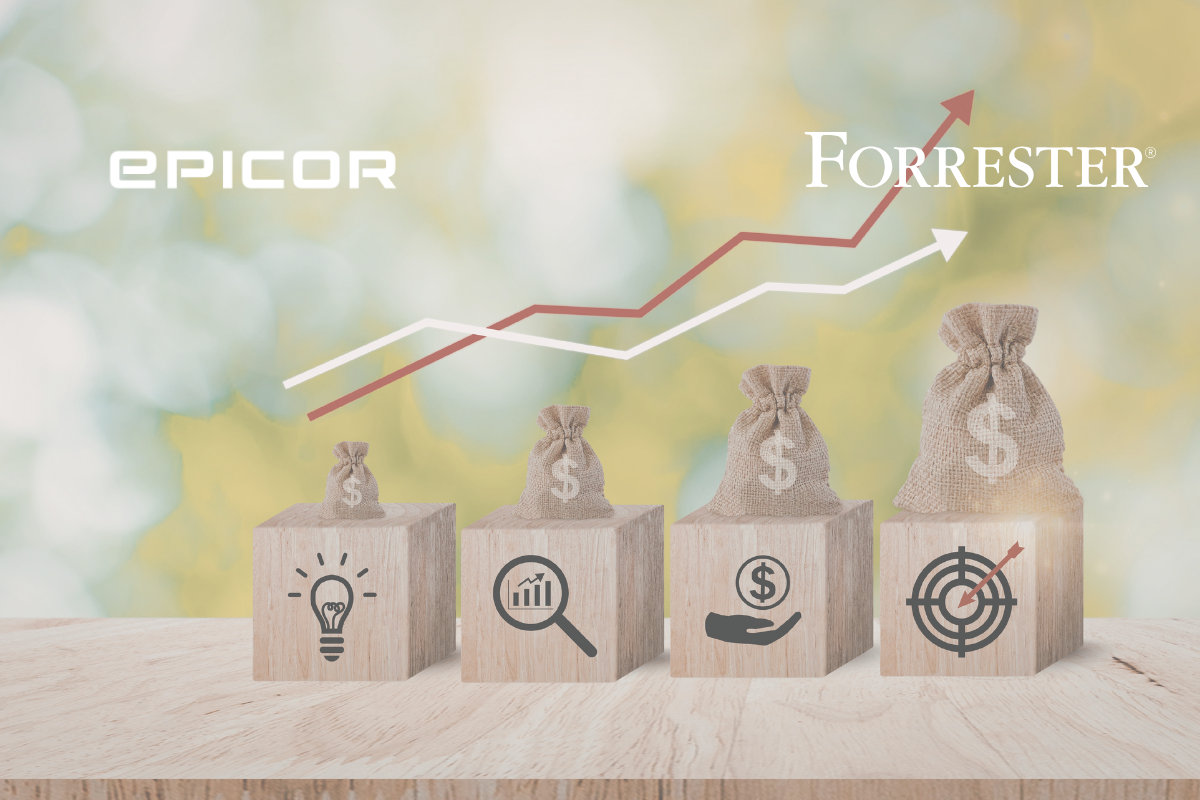

Insights from Forrester’s TEI Study on Epicor Kinetic
What is the real business value of modern ERP in manufacturing?
For many organizations, ERP is no longer just a system of record. It is becoming a strategic platform for operational efficiency, scalability, and data-driven decision-making.
A recent study explores exactly this question—quantifying the financial and operational impact of deploying a modern, cloud-based ERP platform in a manufacturing environment.
The findings provide a clear answer: modern ERP is not just about replacing legacy systems. It is about unlocking measurable business outcomes across the entire organization.
The challenge: why legacy ERP holds manufacturers back
Before adopting modern ERP platforms, many manufacturing organizations face common limitations:
- Fragmented systems across plants and business units
- Limited visibility into operations and performance
- Manual data consolidation and reporting delays
- Difficulty scaling across acquisitions or new sites
As highlighted in the study, legacy systems often lack the flexibility, scalability, and manufacturing-specific capabilities needed to support growth and complexity .
In practical terms, this means:
- slower decision-making
- inefficient production planning
- limited ability to respond to customer demand.
From system replacement to business transformation
What differentiates modern ERP platforms is not just technology—but business impact.
According to the study, organizations that implemented Epicor Kinetic experienced:
- 270% return on investment (ROI)
- Payback period of just 20 months
- $14.8M net present value over five years
These are not abstract metrics. They are the result of specific operational improvements across manufacturing processes.
Value’s source
1. Operational efficiency drives revenue growth
Modern ERP enables manufacturers to improve throughput without increasing resources.
The study shows:
- Up to 6.6% increase in revenue by Year 5
- Reduced lead times and backlog
- Improved on-time delivery
This is achieved through better coordination between production, supply chain, and planning processes .
In reality: more output, same resources.
2. Faster time-to-value from ERP deployment
Unlike traditional ERP implementations, modern platforms reduce deployment time significantly.
- Up to 20% faster deployment
- Faster time-to-revenue realization
This allows organizations to start generating value earlier, especially when rolling out ERP across multiple plants .
3. Improved margins through cost control
One of the most critical impacts is on profitability:
- Up to 1.9% improvement in gross margin
- Better inventory management
- Reduced write-offs
- Improved supplier performance
These improvements are driven by real-time visibility into costs, pricing, and operations .
This is where ERP directly impacts the bottom line.
4. Productivity gains across teams
Modern ERP platforms also transform how teams work:
- +20% productivity for business users
- +40% productivity for ERP/IT teams
Automation, centralized data, and simplified workflows reduce time spent on:
- Reporting
- Data reconciliation
- Manual processes
5. Eliminating legacy costs
Replacing legacy systems also brings direct cost savings:
- reduced maintenance costs
- lower IT overhead
- elimination of redundant platforms.
Over time, organizations can fully decommission legacy ERP systems, simplifying their IT landscape .
Strategic benefits
Not all benefits are easily quantified—but they are equally important.
Organizations reported:
- Improved product quality through better data and traceability
- Increased responsiveness to customer demands
- Higher employee satisfaction through simplified processes
These are the factors that enable long-term competitiveness in manufacturing.
What this means for manufacturing leaders
The key takeaway is clear: Modern ERP is no longer an IT upgrade. It is a business transformation platform.
For manufacturing companies, this means:
- Connecting operations across plants
- Gaining real-time visibility
- Improving decision-making speed
- Scaling efficiently as the business grows

Conclusion
As manufacturing becomes more complex and competitive, the role of ERP continues to evolve.
The findings from Forrester’s TEI study demonstrate that the right ERP platform can deliver:
- measurable financial impact
- operational efficiency
- strategic agility
For organizations evaluating their next step, the question is no longer whether to modernize ERP—but how fast they can unlock its value
ATC as an Epicor Authorized Partner
As Epicor’s Authorized Partner and the Exclusive Distributor of Epicor Kinetic Solutions in Greece and Cyprus since 2001, we believe that this recognition validates our ability to provide manufacturers with the best ERP solutions.