



For years, publisher monetization was framed as a choice between advertising and subscriptions. In 2026, that framing no longer holds. WAN-IFRA’s latest World Press Trends Outlook suggests the industry is moving into a new era shaped by three pillars of revenue: reader revenue, digital advertising, and a fast-growing category of “other” income streams such as events, B2B services, e-commerce, and partnerships. Together, digital and diversified revenue now account for 56.4% of publisher revenues, overtaking print’s 43.6% share.
The old monetization debate is over
This shift has been building for some time. Reuters Institute’s Journalism, Media, and Technology Trends and Predictions 2025 notes that subscriptions and memberships remain the main focus for commercial publishers, but that most companies now combine between two and four revenue streams. In other words, monetization is no longer about selecting one winning model. It is about building a portfolio that fits different audiences, products, and market conditions.
At the same time, payment ceilings remain real. The Reuters Institute Digital News Report 2025 shows that in a group of subscription-oriented markets, only 18% paid for online news in 2025. That is not an argument against reader revenue. It is an argument against relying on reader revenue alone.
The rise of the three-pillar revenue model
The updated WAN-IFRA outlook makes the structural shift much clearer than older industry narratives did. Print circulation and advertising still represent the largest single revenue source at 43.6% of total income among respondents, but digital circulation and advertising now account for 31%, while “other” revenue sources contribute 25.4%. WAN-IFRA also notes that this “other” category has grown from 13.2% in 2021 to more than a quarter of revenue today.
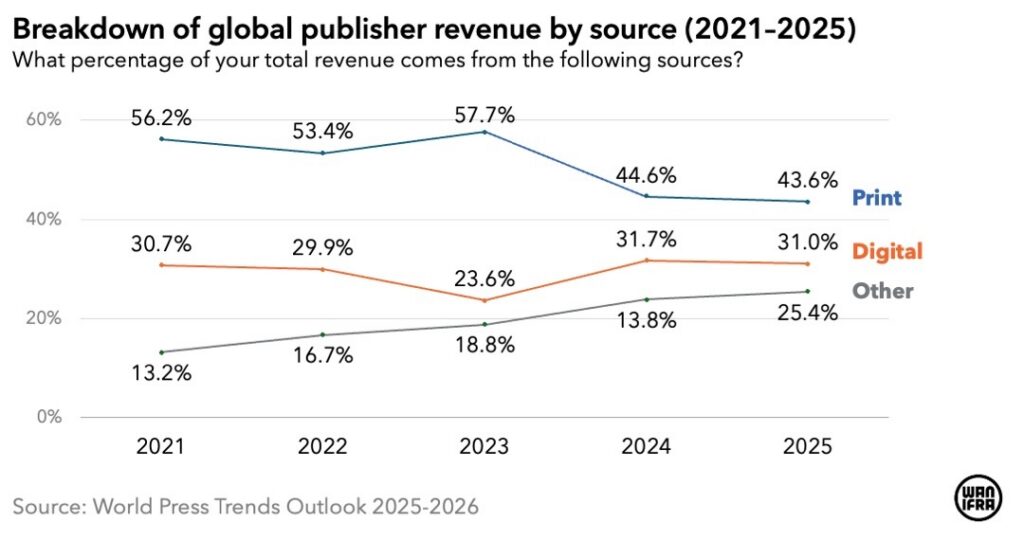
That matters because it changes the way publishers should think about sustainability. The issue is no longer whether digital will eventually replace print. The issue is that publishers are already operating in a more mixed and more complex revenue environment than the old two-model debate suggests. Print remains important, but it is no longer sufficient. Digital matters, but it has largely plateaued at around 30% of revenue over the past five years. The fastest and most reliable growth, according to WAN-IFRA, has come from the third pillar: diversified income streams.
Events remain the most widely cited “other” revenue source, identified by 32.2% of respondents. They are followed by B2B services, content, and partnerships with platforms, both at 16.1%. This is a strong signal that diversification is no longer a side project. It is becoming part of the core publisher business model.
Why diversification is now a business necessity
The wider market context reinforces that point. PwC’s 2025 Global Entertainment and Media Outlook projects advertising to grow faster than consumer spending across the broader E&M sector, but that does not mean publishers can safely fall back on ad-led growth. On the contrary, the market is becoming more competitive, more fragmented, and more dependent on stronger product and audience strategies.
The European context is especially telling. The European Federation of Journalists’ summary of the 2025 Media Industry Outlook says that news media advertising revenue fell from EUR 84.3 billion in 2019 to EUR 77.2 billion in 2023, even as digital newspaper circulation rose 52% over the same period. That is a reminder that audience migration to digital does not automatically translate into stronger economics. Publishers need additional ways to create and capture value.

For larger publishers, the next frontier is ARPU
For larger publishers, the key monetization question is increasingly shifting from subscriber growth to subscriber value. The strongest performers are no longer relying only on more subscriptions. They are improving pricing, retention, bundling, and product mix to lift ARPU over time.
Mather’s 2025 benchmarking is particularly useful here. It shows that median digital-only actives have grown at a CAGR of 6.98% since Q1 2022, but best-in-class publishers are driving digital ARPU at around 25% CAGR, with rates rising to $17.95 per month. That is a very different growth story. It suggests that the next phase of monetization is not simply about adding more users, but about building more valuable product ecosystems around them.
Reader appetite for bundles also supports that direction. Reuters’ Digital News Report 2025 found that 21% of non-payers would be interested in access to more than one news provider for a reasonable price, while 13% would be interested in a bundle with additional services such as sport or games. Those are not majority numbers, but they are large enough to indicate room for broader value propositions beyond a single standalone news product.
For bigger publishers, then, monetization increasingly depends on a coordinated product strategy: subscriptions, bundles, memberships, niche products, newsletters, and premium content offers that together increase engagement, improve retention, and raise ARPU.
For smaller publishers, sustainability depends on community value
For smaller publishers, especially in more constrained markets, the challenge looks different. The path is not simply to imitate large subscription models. It is to build revenue around trust, relevance, and direct audience value.
Greece is a useful example. Reuters’ Digital News Report 2025 says trust in news in Greece remains extremely low: only 22% say they trust the news, the joint lowest level among 48 countries. The same report also shows that only 7% paid for online news in the last year. In a market like that, a pure subscription-first strategy is unlikely to be enough on its own.
News avoidance adds another layer of complexity. Reuters reports that 40% across all markets often or sometimes avoid the news these days, with leading reasons including the negative effect of news on mood and simple overload. That makes value design especially important. If audiences are overwhelmed, then monetization cannot depend on volume alone. It has to depend on usefulness, local relevance, participation, and stronger direct relationships.
This is why for smaller and local publishers, diversified revenue often means a different mix: memberships, niche newsletters, events, archive reuse, practical services, and community-focused benefits rather than a narrow paywall-only logic. In this context, sustainability depends less on copying the biggest players and more on aligning revenue models with audience realities.
What the strongest revenue portfolios have in common
Successful monetization models are not just diverse. They are coordinated.
First, they strengthen the existing product before chasing too many disconnected experiments. Reuters Institute’s 2025 predictions found that 55% of news leaders see strengthening the existing product as the most important route to future growth, compared with 44% who prioritize developing new products and services. That suggests that monetization is increasingly being treated as a product discipline, not just a commercial one.
Second, they package value more intelligently. Bundle interest among non-payers, the rise of memberships, and the growth of value-added offers all point in the same direction: audiences are more likely to pay when the offer feels broader, more relevant, and more useful than a single undifferentiated product.
Third, they use data as a monetization input, not only an editorial one. Mather’s ARPU benchmarking underlines how much value can be created through pricing, segmentation, product mix, and retention strategy, not just content production.
Fourth, they treat “other revenue” as strategic, not secondary. WAN-IFRA’s figures on events, B2B services, and partnerships show that these lines are now material enough to influence business design, not just supplement it.
Monetization is still the weakest AI frontier
One of the most striking findings in the latest WAN-IFRA Outlook is that AI adoption appears strongest in newsroom workflows, but weakest in monetization and audience engagement. More than half of respondents (53%) describe their monetization-related AI efforts as nascent or seriously lagging.
That is an important distinction. The future of revenue growth will depend not only on efficient production, but on smarter monetization operations: bundling, audience segmentation, archive value extraction, newsletter strategy, and value-added offers that can be tested and refined over time.
From subscriptions and memberships to archive reuse and value-added content products, the real challenge is not just identifying new revenue opportunities — it is operationalizing them

From revenue ideas to monetization operations
This is where many publishers still struggle. The industry has no shortage of revenue ideas. The bottleneck is operationalizing them.
It is one thing to talk about subscriptions, memberships, bundles, events, archive monetization, and newsletters. It is another to coordinate them inside one newsroom, one workflow, and one content system. Publishers need the ability to package content differently, support recurring offers, surface archive value, reuse assets across channels, and monitor what is actually performing.
That is where monetization stops being a strategy slide and becomes an operating model. The publishers that move fastest will not necessarily be those with the biggest audiences. They will be the ones that can connect editorial output, audience insight, product logic, and revenue experimentation into one coherent system.
Closing thought
In 2026, publisher growth will depend less on finding one winning model and more on building a revenue portfolio that fits each audience, each market, and each newsroom reality. For larger publishers, that may mean higher ARPU through bundles, memberships, and smarter analytics. For smaller publishers, it may mean stronger community value through newsletters, events, and direct audience relationships. In both cases, the same principle applies: monetization is no longer a side strategy. It is part of how modern publishing is designed.