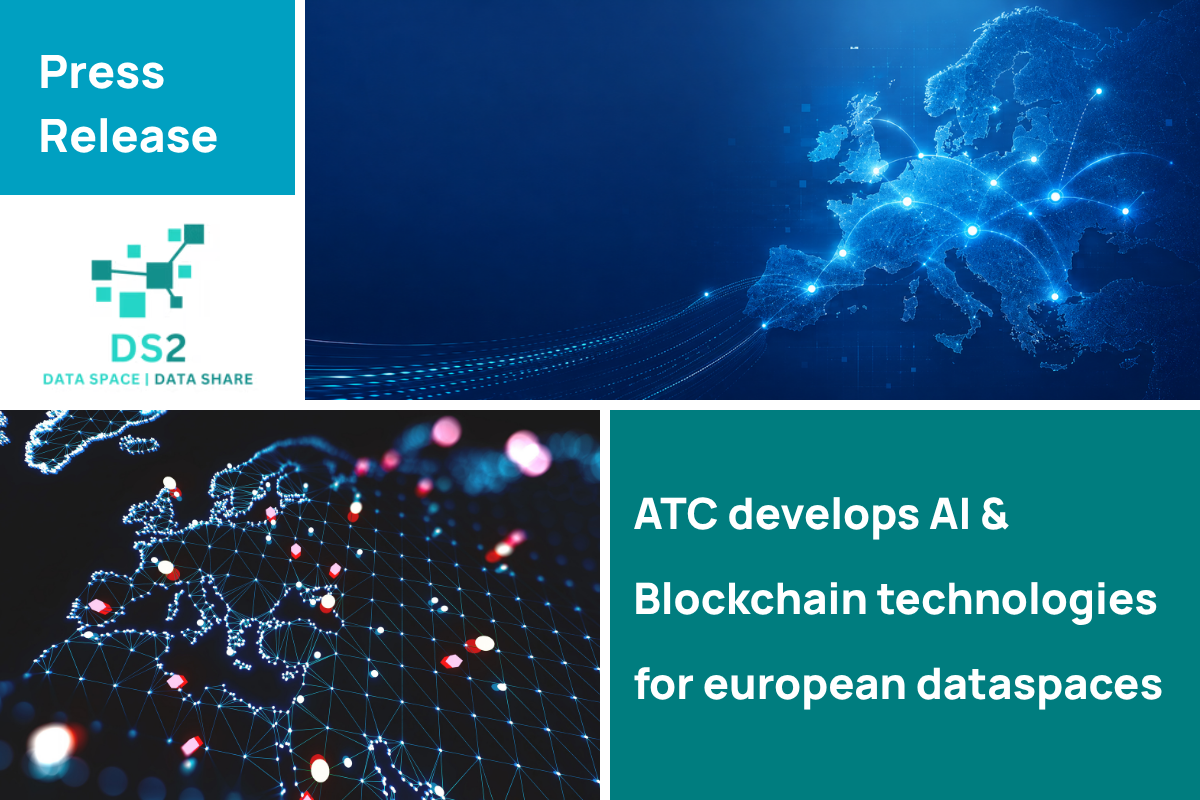

Athens Technology Center (ATC), through its dedicated Innovation Lab, participates as a technology partner in the European project DS2 – DataSpace, DataShare 2.0, contributing to the development of technologies that support secure, interoperable and trustworthy data sharing across different sectors of the European economy.
Funded by the Horizon Europe programme, DS2 aims to connect dataspaces from different domains, enabling organisations, public authorities, businesses and research institutions to share data securely, transparently and under controlled conditions, without relying on centralised platforms or single providers.
Within DS2, ATC is responsible for the design and development of three critical technological modules of the project’s toolkit. The company also contributes to the overall architecture, technical specifications, and the integration and interconnection of the project’s technologies. ATC’s contribution focuses on three areas that are essential for the successful implementation of dataspaces: automation, accountability and traceability, and the creation and comparison of data usage policies.
“ATC’s participation in DS2 reflects our strategic focus on technologies that turn Artificial Intelligence, blockchain and data governance into practical tools for businesses, public organisations and research ecosystems. Through the project, we contribute to the creation of trusted European data infrastructures, where data sharing takes place with security, transparency and respect for data ownership,”
Anna Triantafyllou, Director of ATC’s Innovation Lab.
DARC: a conversational AI assistant for dataspaces
A central element of ATC’s contribution is DARC, a conversational AI assistant that enables users to interact with a dataspace through natural language.
Instead of requiring users to understand the technical architecture, available modules or configuration details of a dataspace, DARC allows them to describe their needs in plain language and receive step-by-step guidance. The assistant supports the discovery of available information, its assessment in terms of relevance, security, interoperability and usage restrictions, the recommendation of possible exploitation scenarios, and the automatic configuration of technological workflows.
In this way, processes that traditionally require significant technical expertise are transformed into a guided conversational experience, making dataspaces more accessible, faster to use and more practically exploitable by organisations across different sectors.
DARC has already received European-level recognition, as the module has been included in the European Commission’s Innovation Radar as a high-potential EU-funded innovation.
DRM: Blockchain-based data rights management
ATC is also developing the DRM – Data Rights Management module, which uses blockchain technology to record critical data-sharing events.
Through a blockchain ledger, DRM enables the traceability and verification of actions such as data access, transfers and the application of usage policies. This strengthens trust between participating organisations by creating a reliable audit trail of who shared what, with whom, when, and under which conditions.
This capability is especially important in decentralised data ecosystems, where organisations need to maintain control over their data while ensuring that all interactions remain transparent, verifiable and compliant with agreed usage terms.
PCR: creating and comparing data usage policies
The third module developed by ATC is PCR – Policy Creation, a tool for creating and comparing data usage policies.
PCR enables the drafting of standardised, machine-readable policies based on the open ODRL – Open Digital Rights Language standard. It also facilitates the comparison, assessment and negotiation of data-sharing terms between different organisations.
By turning policy documents into structured and machine-readable rules, PCR helps dataspaces move beyond static legal documents and towards policies that can be understood, compared and applied by software systems.
Supporting Europe’s data economy
DS2 addresses one of the major challenges of the European data economy: how organisations can share data securely, transparently and under controlled conditions, while preserving data ownership and usage rights.
Dataspaces are a key pillar of the European data strategy. They provide trusted, decentralised environments where data can be exchanged between different ecosystems, while allowing data producers and providers to retain control over how their data is accessed and used.
The DS2 toolkit is being tested in four pilot applications: smart agriculture in Thessaly, Greece; urban sustainability in Cluj-Napoca, Romania; air quality monitoring in Slovenia; and a cross-sectoral pilot connecting the three use cases.
The project is coordinated by the Finnish research centre VTT and brings together 17 partners from 8 countries, with a duration from January 2024 to December 2026. DS2 is funded by Horizon Europe, with complementary funding from UK Research and Innovation.
ATC’s Innovation Lab and European Research
ATC’s participation in DS2 is part of the company’s long-standing research and technological activity in fields such as Artificial Intelligence, data analytics, blockchain, web platform development and the integration of complex information systems.
Through DS2, ATC further strengthens its contribution to European digital infrastructures that support the secure, trusted and effective use of data.