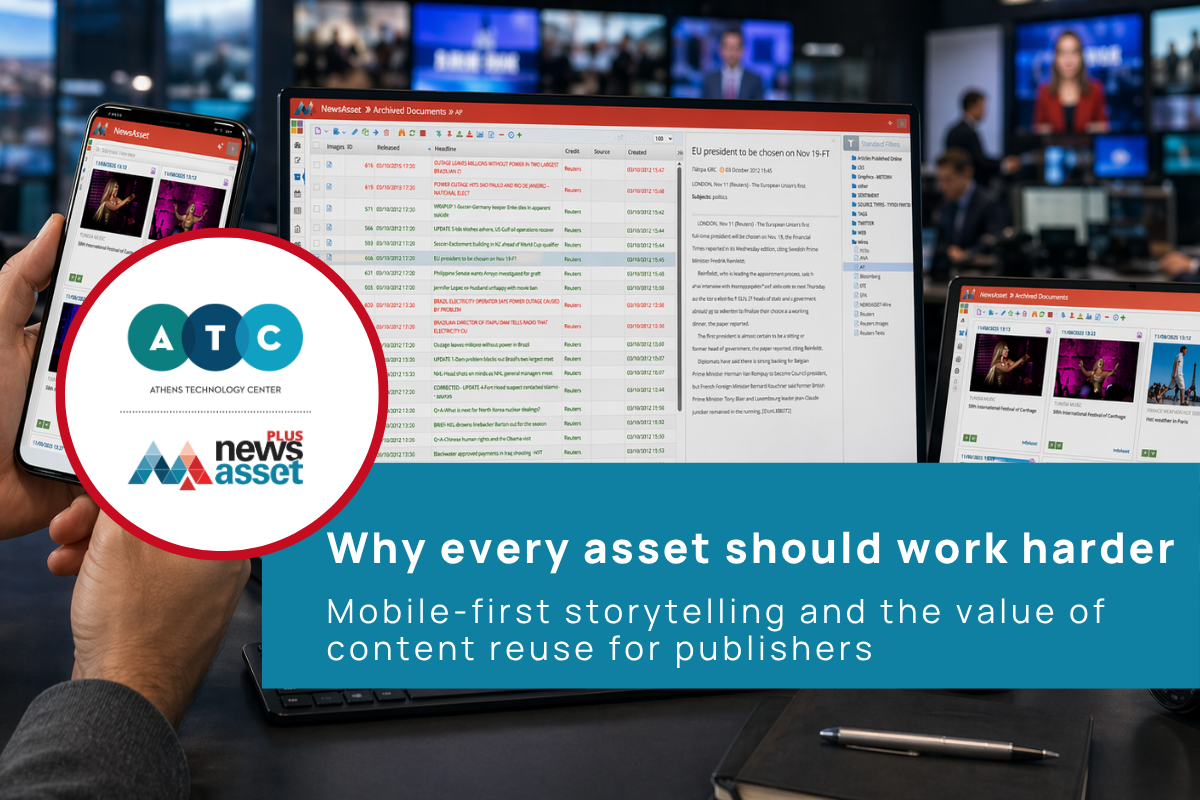

In a mobile-first publishing environment, creating great content is no longer enough. Publishers also need to make every story, video, infographic, podcast, and visual asset easier to store, find, adapt, and reuse across channels.
That is why digital asset management for publishers is becoming more important than ever.
Today, content needs to move across websites, mobile apps, newsletters, social platforms, short-form video, podcasts, and visual storytelling formats. This shift creates new opportunities for engagement, but it also puts more pressure on newsroom teams. Without the right asset management and content repurposing workflow, valuable editorial assets often disappear after first publication.
For modern publishers, the goal is no longer just to publish faster. It is to make every asset work harder.
The problem with one-time publishing
In many newsrooms, content still follows a one-time publishing model.
A story is written, published, promoted, and then effectively lost inside folders, disconnected systems, or archives that are difficult to search and even harder to reuse. As a result, teams often recreate assets they already have, duplicate work across channels, and miss opportunities to extend the value of existing content.
This is one of the biggest hidden costs in modern newsroom workflow.
In a mobile-first newsroom, where the same story may need to appear in multiple formats and platforms, one-time publishing is no longer sustainable. Publishers need a better way to preserve, retrieve, and reuse content without increasing editorial workload.
Why mobile-first publishing increases the need for content reuse
Mobile-first publishing has changed the lifecycle of editorial content. A single story may now need to support:
- a homepage article;
- a mobile alert;
- a newsletter item;
- a social media post;
- a short video;
- an infographic;
- an audio or podcast segment.
The more channels and formats a publisher supports, the more important content reuse becomes.
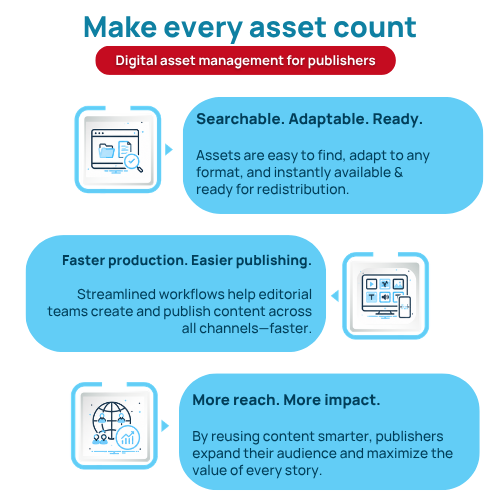
This is why DAM in publishing is no longer just about archiving files. It is about supporting faster editorial production, easier cross-channel publishing, and more efficient reuse of stories and multimedia assets.
When assets are searchable, adaptable, and ready for redistribution, publishers can increase reach without recreating content from scratch.
Modern digital asset management platforms allow publishers to organise content in a way that supports reuse, faster production and distribution across multiple channels.
For large publishers: scale cross-channel storytelling without duplication
For large publishing organizations, the challenge is often complexity.
Multiple editorial teams, desks, brands, and platforms work in parallel. Stories, videos, audio clips, images, and graphics need to move quickly across web, mobile, social, newsletters, and visual storytelling environments while staying consistent and easy to manage.
Without strong digital asset management for publishers, duplication becomes expensive. Teams spend time searching for material, recreating assets, or republishing content inefficiently. Valuable editorial resources are underused simply because they are difficult to retrieve and repurpose.
A stronger asset management for newsrooms approach helps large publishers:
- centralize editorial and multimedia assets;
- reduce duplicated production work;
- support mobile-first and visual storytelling;
- maintain brand consistency across channels;
- improve cross-channel publishing;
- extend the life of every content asset.
For larger publishers, content repurposing is not just an efficiency tactic. It is a way to scale storytelling across formats without adding unnecessary production cost.
For smaller publishers: improve content ROI and make every story go further
For smaller publishers, the challenge is usually not scale. It is limited time, limited people, and limited room for wasted effort.
When a story, podcast, video, or graphic cannot be found and reused later, the original effort loses value. This is why digital asset management in publishing matters just as much for smaller newsrooms.
A more effective DAM for publishers setup helps smaller teams:
- store content in one place;
- tag assets for faster search;
- retrieve stories quickly;
- reuse content in new formats;
- distribute assets across channels with less effort;
- improve the ROI of every story.
For smaller publishers, the benefit is practical and immediate: what gets created today should still be useful tomorrow.
In this sense, content reuse is not just a workflow improvement. It is a growth strategy for lean teams.
Why digital asset management matters more now
Many organizations still think of digital asset management as simple storage. But the real value of DAM in publishing is much broader.
A strong digital asset management for publishers strategy helps newsrooms:
- archive assets centrally;
- organize content with metadata and tags;
- improve searchability;
- support faster retrieval;
- repurpose content across formats;
- simplify cross-channel publishing;
- preserve content as reusable editorial capital;
In a modern newsroom, the archive should not be treated as passive storage. It should function as an active source of reusable material for new formats, new channels, and new storytelling opportunities.
When that happens, asset management becomes part of editorial productivity.
From archive to action: how content repurposing creates more value
The most effective publishers do not treat archived content as dead storage. They treat it as a living library of reusable editorial assets.
A graphic created for one story can become part of a newsletter. A video clip can be reused in a mobile-first social format. An older article can be republished with a new angle. An infographic can be adapted for another audience or channel.
This is the real business value of content repurposing. The key is not just to store assets. It is to structure them in a way that makes future use easy, fast, and natural inside the newsroom workflow. That is what turns an archive into action.
How newsasset PLUS supports digital asset management and content reuse
Newsasset PLUS helps publishers connect digital asset management, search, repurposing, and cross-channel publishing in one environment.
With a centralized content hub and DAM capabilities, editorial teams can:
- store stories and multimedia assets securely;
- retrieve them quickly;
- repurpose them for new formats;
- distribute them across channels more efficiently;
- reduce duplication across the newsroom;
- support mobile-first storytelling with less effort.
For large publishers, that means more control, better coordination, and more scalable storytelling.
For smaller publishers, it means less wasted effort and more long-term value from every story.
Final thoughts: make every asset work harder
In a mobile-first newsroom, every asset should do more than support one moment of publication. It should remain searchable, reusable, adaptable, and ready to create value again and again.
That is why digital asset management for publishers is becoming a strategic priority. The publishers that move faster in the future will not just be the ones that create more content. They will be the ones that manage, reuse, and distribute every asset more effectively.
Because in modern publishing, the real advantage comes when every asset works harder.
See also